
The Future of Cloud Computing: 7 Trends Reshaping Enterprise Tech (2026)
The future of cloud computing is no longer about renting servers — it’s about intelligent, distributed, self-managing infrastructure. IDC projects global public cloud spending will reach $1.6 trillion by 2028, double 2024’s total, and the architecture behind that spending is transforming: AI is becoming the organizing principle of cloud strategy, security deadlines are forcing cryptographic migrations, and workloads are scattering across edges, regions, and providers.
The monolithic data center era is dissolving into seven distinct architectural patterns. Here they are — what each one is, why it matters in 2026, and what your organization should do about it.
1. AI-Native Cloud Infrastructure
What it is: Cloud infrastructure designed around AI workloads first — GPU/TPU orchestration, high-speed interconnects, vector databases, and AI-as-a-Service (AIaaS) baked into every layer rather than bolted on.
Why it matters in 2026: GenAI-specific cloud services are growing 165% year over year, and AI demand is the primary driver behind cloud infrastructure spending hitting $143+ billion per quarter. Hyperscalers are racing to build AI data centers, and enterprises are rebuilding their cloud foundations specifically to operationalize AI — not just host it.
Action step: Audit which workloads could benefit from managed AI services (inference APIs, vector search, agent frameworks) before investing in your own GPU capacity. Renting beats building for almost everyone except the largest AI labs.
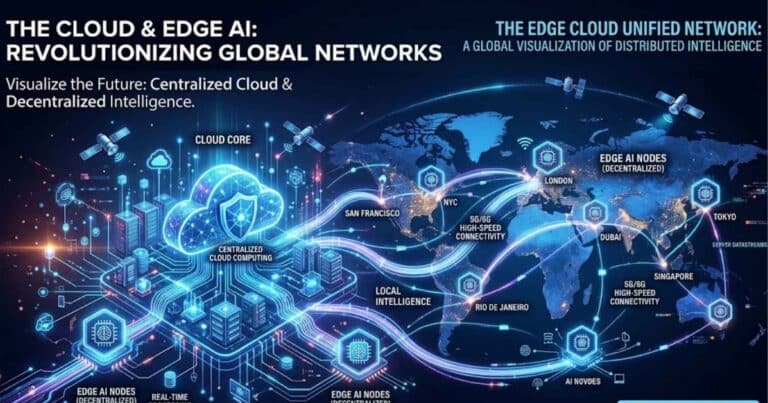
2. Edge AI and Distributed Inference
What it is: Machine learning models deployed on local micro-datacenters, factory floors, retail locations, and IoT endpoints — processing data where it’s created instead of round-tripping to a distant cloud region.
Why it matters in 2026: Edge AI cuts inference latency from ~200ms to sub-10ms, enabling real-time use cases: predictive maintenance in manufacturing, in-store retail analytics, fraud detection at the transaction point, and diagnostics in healthcare that keep sensitive data local. Cheaper power-efficient processors, memory-efficient models, and 5G have made edge deployments practical at scale — and processing locally slashes bandwidth costs too.
Action step: Map applications requiring sub-50ms response times. Pilot edge inference with lightweight frameworks (TensorFlow Lite, ONNX Runtime) on existing hardware before buying specialized edge silicon.
3. Post-Quantum Security
What it is: Migration to post-quantum cryptography (PQC) — NIST’s finalized standards (FIPS 203/204/205) — replacing RSA and ECC encryption before quantum computers can break them.
Why it matters in 2026: This shifted from theory to legal obligation this year. Executive Order 14412 (June 2026) requires US federal high-value systems to complete post-quantum key establishment by December 31, 2030; NIST deprecates RSA and ECC in 2030 and disallows them by 2035. The EU roadmap requires member states to start migration by end of 2026. And because of “harvest now, decrypt later” attacks, data that must stay confidential past 2035 should already be moving to quantum-safe encryption. A FAR Council rule due December 2026 will extend these requirements to government contractors — if you sell to anyone who sells to the government, the 2030 deadline is functionally yours.
Action step: Conduct a cryptographic inventory now — catalog every system using RSA/ECC. Begin hybrid PQC deployments (classical + post-quantum together) within the next 12–18 months.
4. Serverless Architecture 2.0
What it is: Event-driven computing that eliminates infrastructure management entirely — now expanded with GPU-accelerated serverless for AI inference and scale-to-zero pricing that bills only for actual execution.
Why it matters in 2026: Serverless has matured from simple functions into full application platforms. Financial services use it for transaction processing and real-time alerts; media companies run unpredictable traffic spikes on serverless backends; public sector services with variable usage cut overhead dramatically. The catch that emerged this year: serverless needs cost governance too — inefficient function design produces surprise bills, and mature organizations now fold serverless into their FinOps frameworks.
Action step: Identify event-driven workloads (APIs, webhooks, data processing, scheduled jobs) and move one to a serverless pilot. Set invocation-cost alerts from day one.
5. Multi-Cloud Mesh
What it is: Service mesh technologies extended across AWS, Azure, and GCP — a unified control plane for traffic management, observability, and security policy across heterogeneous environments.
Why it matters in 2026: 87% of enterprises now run workloads across multiple clouds, and multi-cloud has shifted from a lock-in-avoidance tactic to a deliberate strategy: placing each workload on the platform where it performs best, satisfies regional compliance, and costs least. The hybrid cloud market alone is projected to grow from ~$130 billion to $310–330 billion by 2030.
Action step: If you’re multi-cloud by accident (different teams chose different providers), invest in a unified observability and policy layer before the sprawl becomes unmanageable. Infrastructure-as-Code with policy guardrails is the backbone.
6. Zero Trust Everywhere
What it is: Security architecture where nothing is trusted by default — every user, device, and workload verifies identity continuously, extended from the network core out to edge devices.
Why it matters in 2026: As infrastructure scatters across clouds and edges, the perimeter is gone. Zero trust is no longer a buzzword but an operational requirement, converging with edge computing into “zero trust edge”: every request authenticated, every connection encrypted, least-privilege access everywhere. AI-powered threat detection and continuous compliance monitoring are becoming standard layers in enterprise cloud stacks.
Action step: Start with identity: enforce phishing-resistant MFA and least-privilege IAM across all cloud accounts, then segment workloads and deploy continuous verification.
7. Agentic AIOps and Platform Engineering
What it is: Two converging shifts — AI agents that autonomously monitor, optimize, secure, and repair cloud infrastructure (agentic AIOps), and internal developer platforms (IDPs) that give engineering teams self-service “golden paths” with automated guardrails.
Why it matters in 2026: Cloud complexity has outpaced human capacity. With 2.4 public clouds per organization on average and skills shortages persistent, enterprises are responding with automation: AI agents that right-size resources, predict failures, and remediate incidents, plus platform teams that standardize deployments so developers never touch raw infrastructure. AIOps is maturing from an experiment into a cloud operations standard.
Action step: Automate the boring first — alerting, scaling, and cost anomaly detection — and stand up an internal platform with templates and policy-as-code before attempting autonomous remediation.
The Seven Shapes at a Glance
| Trend | Core benefit | 2026 maturity |
|---|---|---|
| AI-native infrastructure | Intelligence built into every layer | Rapidly scaling — biggest spending driver |
| Edge AI | Sub-10ms real-time inference | Production deployments across industries |
| Post-quantum security | Encryption that survives quantum attacks | Regulatory deadlines now in force |
| Serverless 2.0 | Zero ops, pay-per-use, GPU support | Mature — governance is the new challenge |
| Multi-cloud mesh | Best-of-breed workloads, no lock-in | 87% enterprise adoption |
| Zero trust | Perimeter-less security | Operational requirement |
| Agentic AIOps & platform engineering | Self-managing cloud operations | Moving from pilot to standard |
How to Prepare: A 5-Step Enterprise Roadmap
When evaluating providers for this roadmap, use our Google Cloud vs AWS comparison alongside the Google server hosting guide to separate platform selection from implementation planning.
- Inventory — map workloads, cryptographic assets, and latency requirements before anything else.
- Prioritize by deadline — post-quantum migration has hard dates (2030/2035); start there.
- Pilot each trend in isolation — one edge AI node, one serverless workload, one PQC hybrid deployment.
- Unify governance — cost, security, and observability policies must work across all your clouds and edges.
- Invest in people — upskill existing teams; automation lowers the expertise threshold, but someone still has to design the guardrails.
Frequently Asked Questions About the Future of Cloud Computing
What is the future of cloud computing?
The future of cloud computing centers on AI-driven automation, edge computing, and cost optimization. IDC projects global public cloud spending will reach $1.6 trillion by 2028 — double 2024’s total — with infrastructure becoming increasingly autonomous, distributed, and intelligent.
What are the biggest cloud computing trends in 2026?
The dominant 2026 trends are AI-native infrastructure, edge AI, post-quantum security migration, serverless computing, multi-cloud strategies (87% of enterprises), zero trust security, and agentic AIOps with platform engineering.
Is AI replacing cloud computing?
No — AI runs on cloud infrastructure and is accelerating cloud growth. GenAI-specific cloud services are growing 165% year over year, and AI demand is the primary reason cloud infrastructure spending is growing at its fastest pace in years.
What is post-quantum cryptography and why does it matter now?
Post-quantum cryptography (PQC) uses NIST-standardized algorithms that resist quantum computer attacks. It matters now because US Executive Order 14412 mandates federal migration by 2030–2031, NIST deprecates RSA/ECC in 2030, and “harvest now, decrypt later” attacks mean sensitive data needs protection today.
What is the difference between edge computing and cloud computing?
Cloud computing processes data in centralized data centers; edge computing processes it near where it’s created — on factory floors, retail sites, or devices. Edge reduces latency to under 10ms and cuts bandwidth costs, while cloud provides massive scale. Most enterprises now use both together.
What is a multi-cloud strategy?
Multi-cloud means running workloads across multiple providers (AWS, Azure, Google Cloud) to place each workload where it performs best, costs least, and meets compliance needs. 87% of enterprises now operate this way, up from niche practice a few years ago.
Will serverless replace traditional servers?
For event-driven workloads, largely yes — APIs, automation, and data processing increasingly run serverless. But long-running, predictable workloads are often cheaper on reserved VMs or containers. The 2026 reality is hybrid: serverless where it fits, traditional compute where it’s economical.
The Bottom Line
The future of cloud computing isn’t one technology — it’s seven converging shapes: AI-native infrastructure, edge AI, post-quantum security, serverless, multi-cloud mesh, zero trust, and autonomous operations. Some are competitive opportunities (edge AI, serverless); one is a legal deadline (post-quantum migration by 2030); all of them reward organizations that inventory, pilot, and govern deliberately rather than react late.
The enterprises that win the next decade won’t be the ones with the most cloud — they’ll be the ones with the most intentional cloud.
Cloud Computing Trends 2026: Edge AI, Serverless & SecurityGoogle Cloud Hosting: Costs, Free Tier & Why SwitchInfrastructure Cloud Computing: The 2026 Guide to Modern ITGoogle Server Hosting: Complete Guide to GCP Cloud Hosting (2026)
One Comment