
Financial Decision: Meaning, Types & Examples (2026)
Every day, individuals and businesses make choices that shape their financial future — where to put savings, whether to borrow, how much risk to carry. Each of these is a financial decision, and the quality of those decisions compounds over time far more than any single income level.
This guide breaks down what a financial decision actually is, the four core types recognized in finance, everyday examples, and a practical process for making better ones.
What Is a Financial Decision?
A financial decision is any choice that involves allocating money under conditions of uncertainty — committing funds today in exchange for expected benefits tomorrow. Some are small (choosing a savings account), some are life-sized (taking a mortgage), and in business they determine whether a company grows, stalls, or fails.
What makes a decision “financial” is the trade-off at its core: risk versus return, today versus tomorrow, cost of borrowing versus benefit of spending. Understanding that trade-off is the foundation of financial literacy.
The 4 Core Types of Financial Decisions
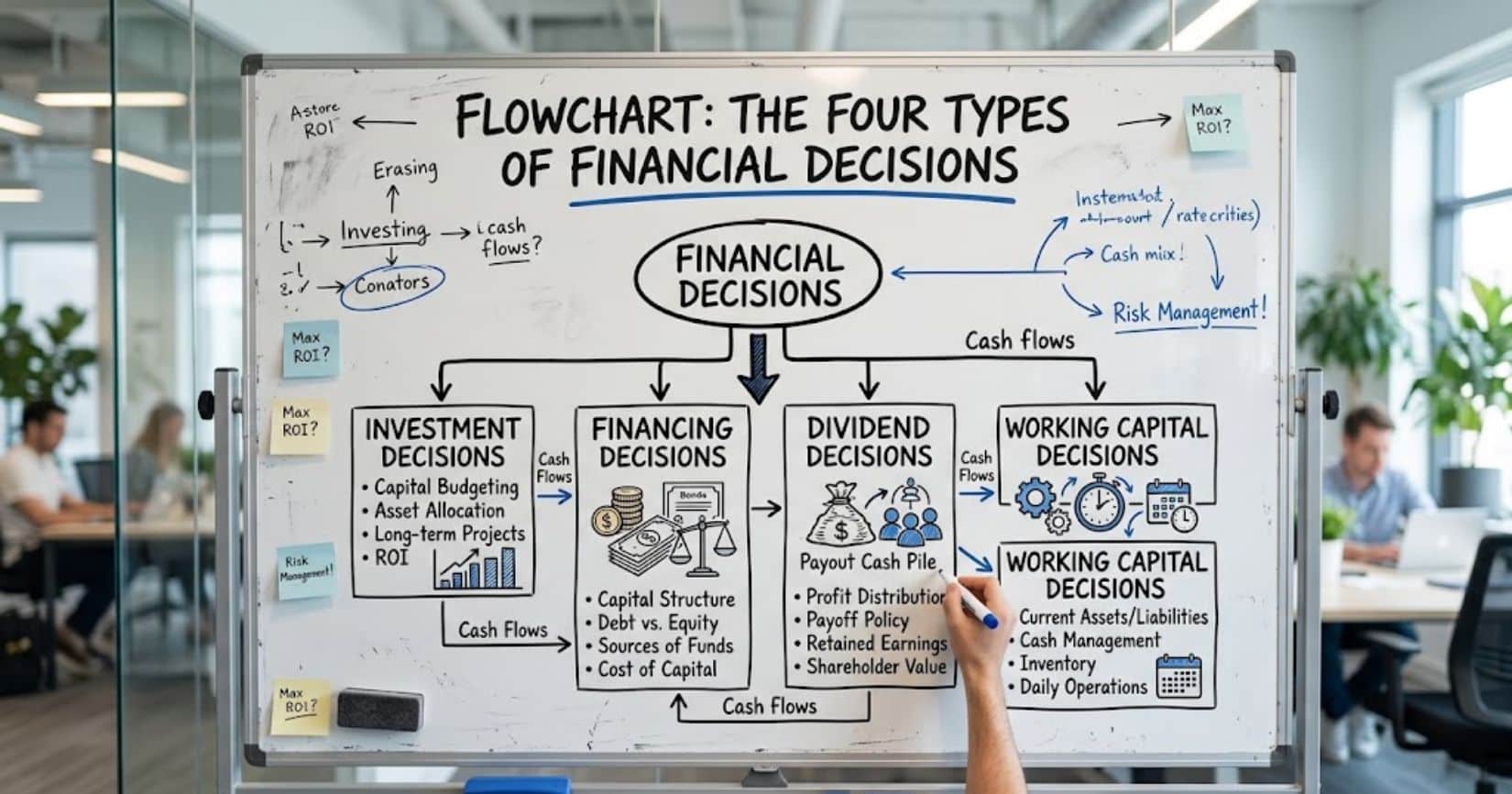
In finance — for businesses and households alike — nearly every money choice falls into four categories:
| Type | The question it answers | Everyday example | Business example |
|---|---|---|---|
| Investment decisions | Where should money go to grow? | Buying index funds, paying for a degree, purchasing rental property | Buying equipment, launching a product line |
| Financing decisions | How should we fund it? | Choosing a mortgage, using a credit line, paying cash vs. financing a car | Issuing shares vs. taking a bank loan |
| Dividend decisions | Distribute profits or reinvest them? | Spending a bonus vs. investing it | Paying shareholder dividends vs. funding expansion |
| Liquidity (working capital) decisions | Can we meet short-term obligations? | Sizing an emergency fund | Managing cash, receivables, and inventory |
Investment decisions commit resources to expected future returns. Financing decisions choose the cheapest, safest way to fund those commitments. Dividend decisions balance rewarding owners today against reinvesting for tomorrow. Liquidity decisions keep enough cash moving to survive the short term — the type most people neglect until it becomes an emergency.
Financial Decision Examples in Everyday Life
To put these choices into practice, work through our budgeting example and guide for first-time investors. They show how everyday spending plans and longer-term goals lead to different decisions.
Abstract types become concrete fast. You make financial decisions when you:
- Choose between paying off a credit card or adding to savings
- Decide how much house or car you can genuinely afford
- Pick insurance coverage levels and deductibles
- Set your retirement contribution percentage
- Take a loan for education or a business idea
- Build (or skip) an emergency fund
Each involves the same core skill — comparing costs, risks, and future consequences instead of reacting to immediate emotion.
Key Factors That Affect Financial Decisions
Five forces shape every money choice:
- Time horizon — money needed in 2 years and money needed in 20 years demand completely different strategies
- Risk tolerance — both emotional (can you sleep at night?) and financial (can you absorb the loss?)
- Income stability — a salaried employee and a freelancer should structure debt and savings differently
- Interest rates and inflation — the price of borrowing and the erosion of idle cash
- Behavioral biases — overconfidence, loss aversion, and herd behavior quietly drive more decisions than spreadsheets do
A 5-Step Process for Better Financial Decisions
Step 1 — Define the decision precisely. “Should I invest more?” is vague; “Should I raise my retirement contribution from 8% to 12%?” is decidable.
Step 2 — Gather the real numbers. Actual rates, fees, balances, and timelines — not assumptions.
Step 3 — Compare at least three options. The first acceptable option is rarely the best one.
Step 4 — Stress-test the downside. Ask: if this goes wrong, what exactly happens, and can I absorb it?
Step 5 — Decide, act, and schedule a review. Every financial decision deserves a revisit date — circumstances and rates change.
Common Financial Decision Mistakes
- Deciding on emotion — panic-selling in downturns, FOMO-buying at peaks
- Ignoring total cost — focusing on monthly payments instead of lifetime interest
- No emergency buffer — a liquidity failure that turns small problems into debt spirals
- Analysis paralysis — waiting for perfect information while inflation taxes idle cash
- Never reviewing — a good decision in 2022 can be a bad one by 2026
Frequently Asked Questions
What are the four types of financial decisions?
The four core types are investment decisions (where money goes to grow), financing decisions (how to fund it), dividend decisions (distribute profits or reinvest), and liquidity decisions (meeting short-term obligations). Together they cover nearly every money choice a person or business makes.
What are the three main types of financial decisions?
Some frameworks simplify to three — investment, financing, and dividend decisions — folding liquidity management into ongoing operations. Both versions are correct; the four-type model just makes cash-flow management explicit.
Can you give an example of a financial decision?
Deciding whether to pay off a $5,000 credit card balance at 24% interest or invest that money is a classic financial decision: it compares a guaranteed 24% “return” (avoided interest) against uncertain market gains — risk versus return in one choice.
What are examples of decision-making in personal finance?
Budgeting monthly income, choosing a mortgage term, setting insurance deductibles, building an emergency fund, contributing to retirement accounts, and deciding when to refinance — each applies the same compare-the-trade-offs skill.
The Bottom Line
A financial decision is not about being rich — it is about being deliberate. Classify the choice in front of you (investment, financing, dividend, or liquidity), run it through a simple five-step process, and review it on a schedule. Small, deliberate money decisions, repeated consistently, build more wealth than any single brilliant move

3 Comments